
The Dash: the most extensive Digital Assembly Line
The Dash* is the product name of the first AI-powered digital assembly line (also called the data assembly line), not only to limit office work so that we humans can do other more important and suitable tasks, but also to respond to the increasing power of big tech and concerns about privacy, productivity and democracy.
The basis of The Dash is Data Supply Chain Management (DSCM). Weconomics focuses mainly on DSCM, the data pipeline before you can use AI for example. We focus on data logistics, which is essentially comparable to physical logistics: storage (CRUD: Create, Retrieve, Update, Delete), transport (Internet), repackaging (structuring, labeling, tokenization, parsing, vectorizing), and adding value (producing information from data or making decisions using, AI agents, Agentic AI).
The Dash enables the use of AI Agents and Agentic AI. It is a ‘self-operating’ collection of technologies, databases, and computer machines to produce reports and information from data, verify claims, facilitate interactions, validate transactions, or just give answers to questions. A digital assembly line is a combination of concepts, including datafication, digital twin, tokenization, Internet of Things, Distributed Ledger Technology (blockchain), rich data, data logistics, smart contracts, data-access tokens, and artificial intelligence.
You put data on the assembly line and at the end, a CSRD-report, shipment offer, mortgage quotation, government tender, or AML or KYC process is delivered. The Dash is developed by Weconomics Technologies. Weconomics transforms organizations into decentralized autonomous organizations. The future is durable, digital, decentralized, and humane. It’s time for the next leap in organization and data technology.
The challenge
Regulation (think of AML, KYC, GDPR, ESG, CSRD) is needed to restrict the free market because the free market does not take externalities into account (carbon emissions, climate change, inequality, etc.). Many organizations say that more regulation leads to more bureaucracy, complexity, and work in a shrinking labor market and pensionable IT-systems. But that’s not true. Our advice: don’t blame regulation for increasing work, bureaucracy, and complexity; blame the use of obsolete IT systems and the lack of rich data in value chains.
If generative AI can provide answers to questions and predict the next word in a sentence based on data, training, and algorithms, it can also plan for the next transport services, optimal stock management, and staff deployment, provide ESG/CSRD reporting, and, more importantly, plan for the lowest carbon emissions.
For instance, we can produce a dataset of all the transport capacities offered and needed in Europe. Not the free market will allocate (the transport company with the best offers/price) in the best way (for shareholders or governments but generative AI will do this for the sake of humans and society with the lowest carbon emissions. It will predict the next transport capacity with the lowest emission in that situation.
But this will not happen if only big tech or central governments gets its hands on AI. We need rich data, the right governance, economics, and a digital assembly line to report on increasing (non-financial) KPIs.
So, no longer is the free market the proven mechanism to execute transactions, but technology (of course, you could also see the free market as a technology, but it became an ideology for many).
If and only if we put technology not in the hands of big techs and autocrats but in the hands of communities, ecosystems, real democracies, and private-public cooperation, we will have the technology in place to solve our fundamental problems, such as the productivity paradox, the purpose of work, the power of big tech, fake news, privacy, and climate change.
More regulation is not the problem; poor data organization in value chains is. A bigger challenge is the combination of several factors that will cause the data and IT infrastructure of most organizations to change drastically. Examples of these issues are: non-transparent algorithms, sunk costs / technical debt, misuse of data monitoring, impaired coordination, data leaks & cyber security and function creep.
Most digital infrastructures and IT-systems are not internet-, blockchain-, and AI-native
Besides combating digital waste and all kinds of other challenges, we mainly focus on the TAPSIX problems (TAPSIX is a combined device for releasing improvements with a transformation focus on perspective change, system leadership, relevant technologies and transition). TAPSIX are the drivers for a durable, digital, decentral and human-oriented future and consist of the following aspects:
- Trust (scalable, with a shared reality we trust each other)
- Attention (from attention to intention economy)
- Productivity (hardly growing and puts a ‘bomb’ under our prosperity)
- Purpose (of office work)
- Privacy (GDPR compliant, company sensitive data)
- Power (Big Tech)
- Propaganda (Fake news, disinformation)
- Processes (including security and sustainability reporting in value chains)
The solution
One of the new organization concepts to accomplish this is called: the digital assembly line; a combination of different tech components such as: datafication, digital twin, tokenization, internet of things, sensors, shared ledgers, blockchain, rich data, data-access, data logistics, smart contracts, decentralized autonomous organizations, artificial intelligence and automated market makers.
A secured, shared, distributed and accessible ledger holds rich data that, together with data logistics, assembles data into information and verifies all kind of claims. Imagine when your chat uses rich data to transform questions into answers? This will reduce digital waste and organizational costs by tens of percent. We will become more productive and with the surplus time solve societal problems.
The Dash can largely solve organizational problems. It is not only waste but also low productivity growth, high costs, long lead times, inaccurate planning, bureaucracy, complexity, and privacy. Major societal challenges such as climate change, the energy transition, the next pandemic, the power of tech companies, disinformation, and the negative side of AI can also largely be solved through the correct use of data. A digital assembly line is an automated concatenation of reliable, accessible decentral databases and processors within an ecosystem. It is an organizational concept that organizes the supply and demand of data at the lowest friction. The Dash makes it possible for buyers and sellers in thick markets to do business without local IT systems, the use of expensive middlemen, or complex contracts. The digital assembly line has many similarities with the origin and principles of the physical assembly line. What the physical assembly line did in factories, the digital assembly line will do in offices? By reducing digital waste in offices, we become more productive. Organizations will choose our solution because they can save up to 30% of their total organization costs.
Components
An digital assembly line roughly consists of the following components:
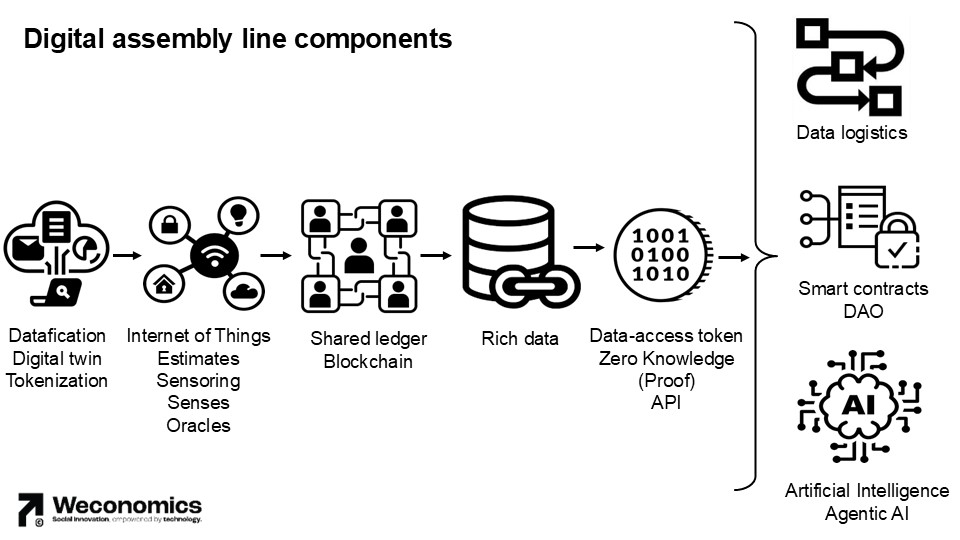
- Datafication: first you need to represent physical values (product, services, rights, measurements, Real World Assets etc.) and processes with zeros and ones (datafication, digital twin, tokenization).
- Establish facts: this can be done with standardized and normalized estimates, senses and sensors (Internet of Things). First, you have to represent physical values (product, services, rights, measurements etc.) and processes with zeros and ones (datafication, digital twin, tokenization, oracle) and find a consensus on whether or not a transaction took place.
- Shared ledger (e.g. Blockchain): storing facts about which there is consensus and can no longer (unilaterally) adjust them (shared and often distributed ledgers).
- Rich data: Rich data is not the same as big data and has characteristics such as accessibility, accuracy, completeness, censorship—and tamper proof, consistency, integrity, interoperability, minimization, portability, relevancy, security, self-sovereign identity, shared meaning, shared reality, sustainability, transparency, and uniqueness.
- Access to facts: organizing access to facts under certain circumstances for specific purposes and target groups and with certain restrictions. You can use Zero Knowledge Proof technology for this. You can verify a claim (e.g., are you 18 years or older?) without revealing the data used (date of birth). With a data-access token, you produce information, get an answer to a question, or verify a claim.
- Combining facts via data logistics: just like a bill of materials in the factory at specific workstations (databases and information production facilities), convert data into information, verify claims, provide answers to questions, etc., to arrive at the end of the assembly line as a shipment offer, for example.
- Smart contracts: a smart contract is an agreement between two actors in the form of a software program. The advantage of this is that the software program and, thus, the contract can be executed automatically. The smart contract executes automatically if the correct conditions are met, which are also stated in the smart contract.
- Enriching facts (algorithms, AI): with AI, rich data can be trained and used to produce information out of data.
Technologies and concepts
A digital assembly line is an example of a decentralized autonomous organization (DAO, or you could say a self-executing office similar to a self-driving car, such as a Tesla). Technical components and concepts for the digital assembly line are for examples: AI Agents, DePIN (Decentralized Physical Network), User Interfaces (UX/UI), Authentication, Datafication, Digital Twins, Tokenization, the Internet of Things, Sensors, Shared Ledgers, Blockchain, Rich Data, Smart Contracts, Data Logistics, Agentic Observation and Orchestration, ETL (Extract, Transform and Load data), CRUD (Create, Read, Update and Delete data), Application Programming Interfaces (API), Data Access Tokens (DAT), Decentralized Autonomous Organizations (DAO’s), Web3, Large Language Models (LLM’s), Retrieval-Augmented Generation (RAG), MCP (Model Context Protocol), Spatial Computing, Automated Market Makers. Generative AI as part of the digital assembly line enhances productivity, significantly reduces office costs, and enables the generation of multiple sustainability reports without increasing bureaucracy or complexity.
Business model & target market
We started the introduction of The Dash via simulations in the Finance, HR-, healthcare-, supply chain- and government domain. Our customers are already in our certified transformation programs for a durable, digital, decentralized, and more human society. Organizations can use their application or, if still present, their intermediary to connect to The Dash via a connector. The revenue model of The Dash is simple: just as you pay for your utility services via an advance invoice per month and a settlement at the end of the year for your used kilowatt-hours, you also do this with The Dash. Billing is based on the number of interactions and transactions (computation, storage, and connections). It is not yet possible to determine the price per interaction and transaction, but it is far below the current transaction costs.
Competition and marketing strategy
An digital assembly line is not new. For example, when you log in with your Google account on a different website, an assembly line will already be processing your request. However, at the moment, developing and applying the concept of Agentic AI in combination with a digital assembly line within a data-driven ecosystem is new. We expect competition from software companies, platforms, and tech companies. They will be interested in a digital but maybe less in a durable, decentralized, and more human future. We work with other organization for example on the High Tech Campus Eindhoven. Furthermore, we offer certified programs to familiarize organizations with the digital assembly line and ecosystems.
Your advantages
With The Dash, organizations can use generative AI and reduce operational office costs by at least 30%. Organizations can also reduce lead times and improve performance and the quality of services. The system will produce SDG/ESG/CSRD reports, reduce complexity and bureaucracy and enable a decentralized autonomous organization (a kind of Tesla office) with minimum human interactions, big tech power and maximum privacy by design.
More information
If you are interested in our solutions, please contact us.
* The Oldsmobile Curved Dash is credited as being the first mass-produced automobile with an assembly line (1901).
tags: dal, data-assembly_line, digital_assembly_line
 Weconomics Technologies